
Furniture handling shapes the pace of a business move. Businesses searching for commercial movers in Buford, GA should clarify whether the service covers furniture disassembly and reassembly, loading, and unloading. These tasks prepare furnishings for transport and help place them in the new workspace.
It’s reasonable to want a clear picture of what a moving crew will handle, especially when large or assembled furniture is involved. Before booking, confirm which pieces need to come apart, what should be reassembled, and where items should go after unloading.
This guide explains how furniture breakdown and setup, loading, and unloading fit into a move plan. It also covers how to organize the work and handle furniture at both ends of the move. Knowing what each stage involves helps you plan an orderly transition and choose the right support.
Key Takeaways
- Understand how a moving crew can organize furniture disassembly, loading, unloading, and reassembly as one coordinated process.
- See how furniture size, access routes, and placement plans shape the handling plan for a commercial move.
- Learn which building access and parking details can affect move-day logistics in Buford.
- Know how clearing out unwanted business items can support a smoother transition to a new workspace.
- Find out when commercial junk removal or a dumpster rental can help manage items that won’t be moving with the business.
Loading and unloading
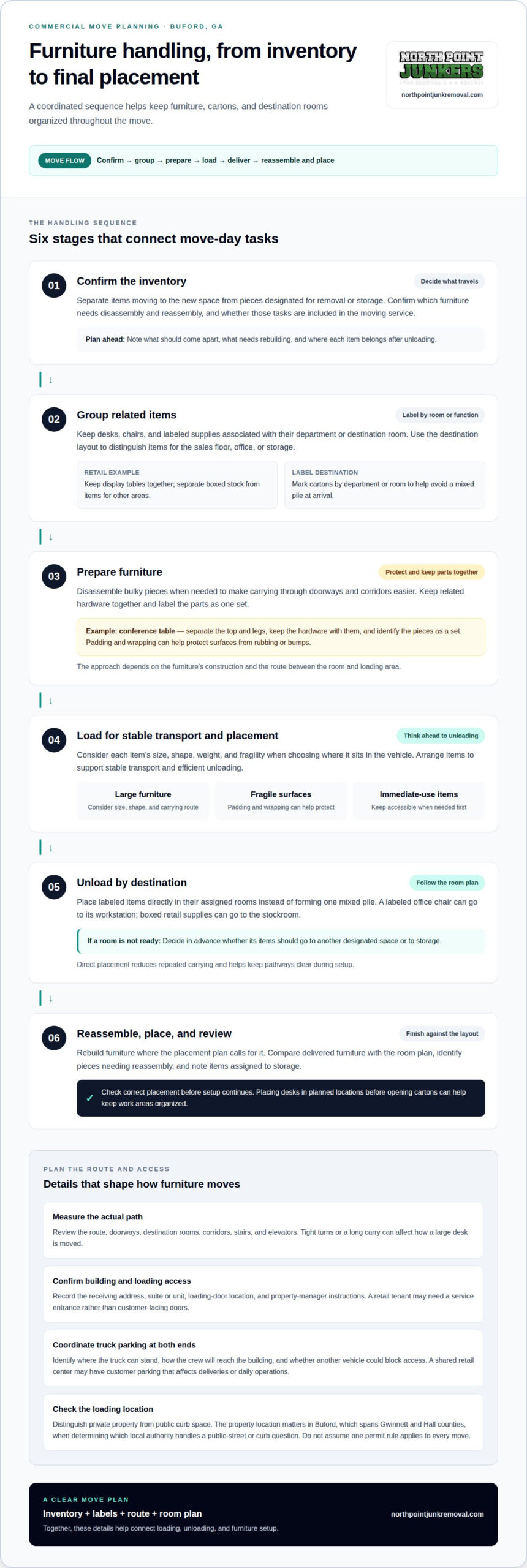
For a Buford, Georgia, business move, loading and unloading work best as a planned sequence. Identify what travels, protect each piece, load items for transport, then place them where they belong. Commercial movers in Buford, GA may coordinate furniture disassembly and reassembly, so confirm that these tasks are included before arranging the move.
Before loading begins, review the inventory and destination layout. A retail shop, for example, may need display tables kept together while boxed stock stays separate. Clear labels and a room plan help distinguish items for the sales floor, office, or storage. This preparation reduces the chance of boxes intended for the back room ending up in the wrong area.
Loading is more than fitting items into a vehicle. Consider each piece’s size, shape, weight, and fragility, then choose a position that supports stable transport. A tall cabinet, for instance, needs a different approach from stacked cartons or a rolling chair. Padding and wrapping can help protect surfaces from rubbing or bumps while items are carried and moved.
Plan the loading sequence around the destination setup. Furniture that will sit against a wall can be loaded with its room assignment in mind, while items needed immediately should remain accessible. Group labeled cartons by department or function. This makes unloading more direct and reduces extra handling through hallways or shared work areas.
Disassembling furniture can make bulky pieces easier to carry through doorways and corridors. For a conference table, separate the top and legs, keep related hardware together, and label the parts as one set. Reassembly at the destination should follow the placement plan. The right approach depends on the furniture’s construction and the route between the room and loading area.
- Confirm the inventory. The crew separates items moving to the new space from pieces designated for removal or storage.
- Group related items. Desks, chairs, and labeled supplies stay associated with their department or destination room.
- Prepare furniture. Pieces that need disassembly are handled before carrying, with parts kept together.
- Load by placement order. The crew arranges items to support stable transport and efficient unloading.
- Unload by destination. Labeled items go to their assigned rooms, rather than forming one mixed pile.
- Reassemble and place. Furniture is rebuilt where the layout calls for it, then checked for correct placement.
At unloading, the destination plan becomes especially useful. A labeled office chair can go directly to its workstation, while boxed retail supplies can be placed in the stockroom. This reduces repeated carrying and helps keep pathways clear during setup. If a room is not ready, decide in advance whether its items should go to another designated space or storage.
Distance also shapes the handling sequence. A short carry from a nearby loading area differs from a longer route through a building, and stairs or tight turns can affect how a large desk is moved. Review the actual path, doorways, and destination rooms before deciding how to carry each item. Accounting for these details supports careful furniture handling.
Supplies and access details belong in the plan, too. A clear route lets the crew move furniture without navigating around loose cartons or retail displays. The business’s layout, loading access, and furniture condition influence how the crew stages items. These practical details matter more than a general online rating alone, because a rating cannot show whether the moving process fits a particular floor plan.
A well-organized unloading stage ends with a placement review. Compare the delivered furniture with the room plan, identify pieces needing reassembly, and note items assigned to storage. For example, placing desks in their planned locations before opening cartons helps keep work areas organized. A clear sequence supports setup instead of leaving the business to sort through a mixed load later.
What should businesses know about moving permits, building access, and parking in Buford, GA?
In Buford, Georgia, a commercial move involves more than choosing a truck arrival time. The business address, loading area, building rules, and route from curb to suite all shape the plan. Because Buford spans Gwinnett and Hall counties, the exact property location matters when determining which local authority handles a public-street or curb question.
There isn’t one permit rule to assume for every Buford move. A truck parked entirely on private property raises different questions from one occupying public curb space. Identify the loading location, the truck’s footprint, and whether the plan uses a public street. These details help determine whether a permit or other authorization applies.
Review building access separately. A downtown office, a retail unit in a shopping center, and a standalone warehouse can each have different entry arrangements. Record the receiving address, suite or unit, loading-door location, and access instructions from the property manager. For example, a retail tenant may need to use a service entrance instead of the customer-facing doors.
Physical constraints affect how furniture and cartons reach the truck. Narrow corridors, stairs, elevators, door widths, and loading-dock height can change the route. Find out which entrance serves the business and where large items can pass safely. An office desk that fits through the main entrance may not fit through a rear service door, so plan the route accordingly.
Coordinate parking at both the origin and destination. Identify where the truck can stand, how the crew will reach the building, and whether another vehicle could block the approach. At a shared retail center, for example, a truck in customer parking may interfere with deliveries or daily operations. A designated loading zone or private lot can provide a clearer staging point.
Property managers may set access windows, loading-dock procedures, elevator reservations, or rules for protecting common areas. These building rules do not replace any public-space permit. Sharing the details beforehand helps the crew align arrival and carrying routes with the property’s process. If an elevator is shared, include its use in the plan alongside regular tenants’ access.
To organize these details, the moving coordinator can follow a clear sequence:
- Map both addresses. Record the street entrance, loading point, suite, and planned furniture route.
- Separate public from private space. Identify whether the truck or equipment will use a public curb or remain on private property.
- Coordinate building access. Gather property-manager instructions for doors, docks, elevators, and access windows.
- Plan truck placement. Choose a position that leaves the entry and nearby business activity accessible.
- Share the final plan. Give the crew the access route and parking instructions before moving day.
Timing can affect access. A retail location may need loading outside its busiest customer period, while an office move may depend on building access hours. Match the requested arrival time to the property’s actual access window. This helps avoid arriving at a locked service entrance or an unavailable dock.
For a move involving a public curb, identify the relevant authority for that specific address and follow its process. The property manager can explain private-site rules, while local officials can address public-street use. Keep these roles distinct so building approval is not mistaken for permission to occupy public space.
Keep one access plan for both sites, including a contact person, entry instructions, truck location, and any approved loading point. If a doorway or dock becomes unavailable, the crew can use the documented alternative route instead of improvising around a blocked entrance. In Buford, clear access details help keep the move organized from the first stop to final placement.
For a business comparing providers, the BBB directory shows 946 moving company results near Buford, Georgia. The BBB directory displays 15 pages of moving company search results near Buford, Georgia. These listings can help build a candidate pool, but they do not resolve whether a crew can use a particular loading area or meet a property’s access rules. Confirm the service scope, arrival plan, and building coordination directly with the provider before finalizing the move.
North Point Junk Removal: Commercial Junk Removal
North Point Junk Removal provides commercial junk removal for businesses clearing furniture, equipment, and other unwanted items during a move. Use this service for items that should leave the workspace rather than travel to the new location. Separating them from the moving inventory keeps the relocation plan focused on what the business will use.
For a larger cleanout, North Point Junk Removal offers dumpster rentals to manage unwanted materials on site. Choose this option when you want to dispose of debris at your own pace. Residential junk removal and hoarding clean-up are also available for those specific needs.
Whether you’re preparing a retail space, office, or other business property, North Point Junk Removal can help clear items that aren’t part of the move. Contact North Point Junk Removal to discuss commercial junk removal for your transition.
Make the Next Move Easier to Manage
Plan the transition around what your business needs to keep operating, not just what needs to leave the building. Choosing commercial movers in Buford, GA is one part of that plan; deciding which furniture, equipment, and supplies belong in the new location is another. A clear keep, move, and remove plan helps prevent unwanted items from following you into the next workspace. For business owners shifting toward flexible, home-based models, resources from Bunnymama.biz can provide useful guidance on building and marketing an online enterprise.
For items that won’t make the move, North Point Junk Removal offers commercial junk removal. The company also provides residential junk removal and hoarding clean-up for those specific cleanout needs. Separating removal from relocation can give your team a more focused start in the new space.
When you’re ready to plan the cleanout, contact North Point Junk Removal. A thoughtful transition can make room for what comes next.
You May Also Like
Construction Dumpster Rental in Buford, GA: Sizes and Pricing
For a construction dumpster rental in Buford, GA, a roll-off dumpster is a temporary container delivered to a project site for debris. Available…

Foreclosure Cleanout in Buford, GA: A Practical Guide to Choosing Help
A foreclosure cleanout in Buford, GA, can go wrong before the first item leaves the property. If ownership or removal authority isn’t clear,…

Playset Demolition and Removal in Buford: Your Complete 2026 Guide
You look out at your Buford backyard and see it: the once-loved swing set is now a graying monument of rotted cedar and jagged, rusty bolts. It’s no…