
A careful unload starts with a clear plan. Unloading services in Alpharetta coordinate arrival, account for property access, and place belongings where they need to go. An organized sequence helps keep work moving and limits unnecessary handling. Clear instructions make arrival and placement easier to coordinate.
It’s understandable to want careful handling and a dependable arrival plan, especially when other move-in or delivery arrangements depend on the unload. This article explains what professional unloading can involve, how teams coordinate timing, and which details can affect the work. You’ll also learn what information to share when arranging service so the crew can plan for the belongings, access, and placement involved.
Key Takeaways
- Learn what can shape an unloading quote and why the job’s scope matters when comparing hourly and flat-rate pricing.
- Understand how stairs, long carries, heavy belongings, and restricted access can affect the work and its cost.
- Know which questions about insurance and damage protection can clarify how your belongings are covered.
- Share clear details about the load, property access, and placement needs to help the team plan the unload and arrival.
- See when junk removal, cleanout services, or a dumpster rental may be useful alongside a move.
Do Alpharetta unloading companies charge hourly or by the job?
Pricing for unloading services in Alpharetta may be hourly or based on the agreed job scope. Hourly billing ties the charge to crew time, while a job-based quote sets a total for the described work. The right structure depends on what needs unloading, where items are going, and how clearly the work can be defined beforehand.
With hourly billing, the amount depends on time spent working. A compact load going from a truck into an accessible ground-floor room may take less time than a mixed load requiring careful placement in several rooms. Crew size, carrying distance, stairs, and item handling all affect the time required. Ask how work time is counted and whether travel or waiting is treated separately.
A job-based quote estimates the described task as a whole, such as unloading a specific shipment and placing items in designated rooms. This can make the expected charge easier to understand before work begins. Accuracy depends on the details provided: load size, large or awkward items, property access, and requested placement all help define the scope.
For example, “unload a truck” leaves important details unclear. A more useful description identifies the truck’s contents, the destination floor, and whether boxes go into one room or several. If the load includes a piano, a narrow stairwell, or a longer carry than described, the work differs from the original outline. A clear scope helps everyone understand what the quote covers.
Before choosing a billing method, compare what each estimate includes, not just its format. Ask what tasks the crew will handle, which access route the estimate assumes, and how added work is treated. For an hourly estimate, find out how time is recorded and progress communicated. For a job-based estimate, confirm which belongings and placement instructions define the scope.
- Load: Explain whether the shipment contains boxes, furniture, appliances, or mixed belongings.
- Access: Describe stairs, elevators, entry points, and the distance from the unloading area.
- Placement: List the rooms or areas where belongings should be left.
- Special handling: Identify unusually heavy, fragile, or awkward items before the estimate.
These details make estimates easier to compare. One provider may quote by crew time, while another gives a set price for the job. If one estimate assumes ground-floor access and another includes an upstairs destination, they describe different work. Ask for the assumptions in plain language, then compare the same load, route, and placement needs.
Timing can affect an hourly job’s final charge. A delayed building entry, unavailable elevator, or blocked unloading area can prevent the crew from moving belongings efficiently. A job-based estimate can also be affected if conditions or requested tasks differ from the agreed scope. Share arrival instructions and access details early, especially for apartments, offices, or buildings with scheduled loading areas.
The price depends on the job and is provided after a quote request. Key factors include load size, crew time, access, carrying distance, item weight, and placement requirements. A useful estimate connects those details to a clear description of the work. Before booking, make sure the billing method, included tasks, and process for added work are easy to understand. This gives you a practical basis for planning the unload.
Are there extra fees for stairs, long carries, heavy items, or limited access?
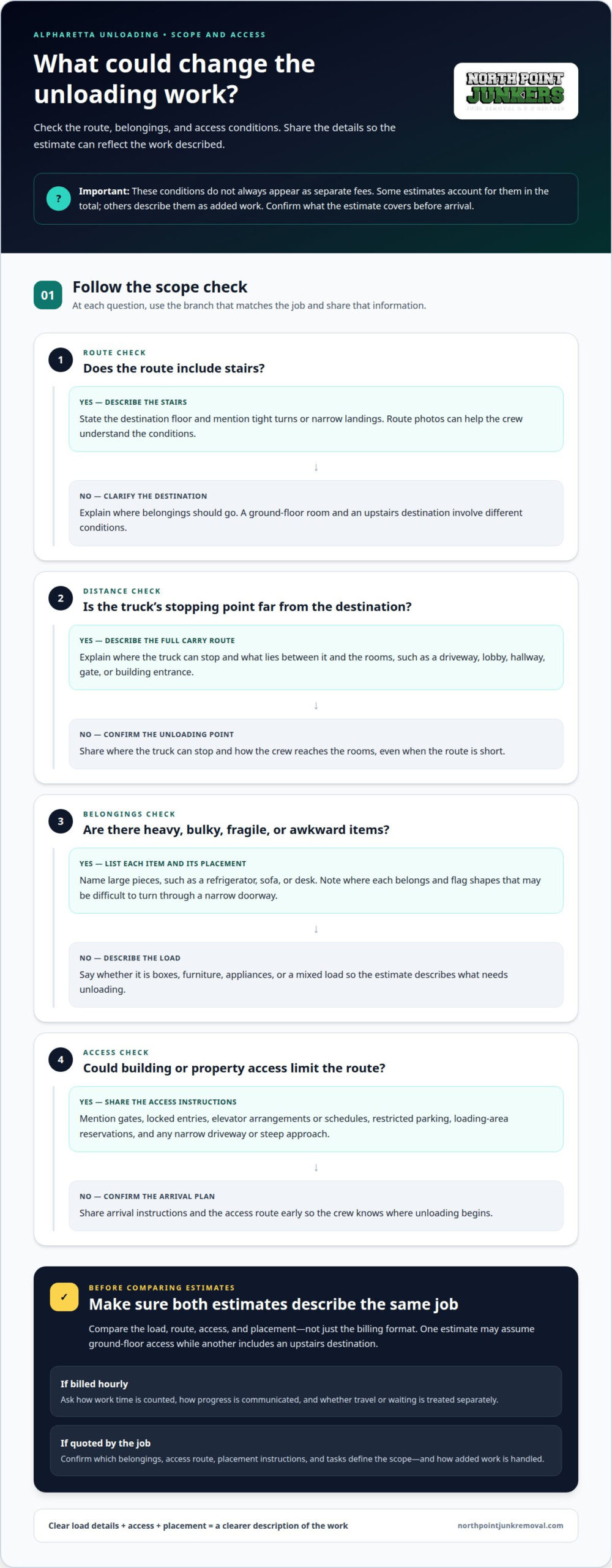
Stairs, long carries, heavy items, and restricted access can change the unloading work and its quoted cost. A crew carrying boxes into a ground-floor room faces different conditions from one taking furniture upstairs. These details don’t always appear as separate fees. Some estimates account for them in the total, while others describe them as added work. The key is understanding which conditions the estimate covers before the crew arrives.
Stairs affect the route and handling required for each item. Taking a sofa up a flight requires more coordination than placing boxes beside the entrance. A narrow landing or tight turn can also affect how furniture moves. Describe the floor, stairway, and difficult turns when requesting an estimate. Route photos can help the crew understand the conditions.
Long carries matter when the unloading point is far from the final room. For example, a truck parked at the curb may leave the crew carrying boxes along a driveway, through a lobby, and down a hallway. A loading area near the entrance creates a shorter route. Share the distance and any gates, corridors, or building entrances between the truck and destination.
Identify heavy or awkward belongings clearly. A refrigerator, sectional sofa, or large desk needs different handling from small cartons. Shape matters too: a long table may be difficult to turn through a narrow doorway, even if it isn’t especially heavy. List bulky items separately and note whether each belongs upstairs, downstairs, or in a particular room.
Limited access can affect the crew’s route before any item is lifted. A reserved loading zone, locked entry, elevator schedule, or narrow driveway can change where unloading begins. For an apartment building, explain how the crew reaches the unit and whether an elevator serves the destination floor. For a home, mention any steep approach, gate, or entrance that limits movement.
Use a simple scope checklist when describing the job:
- Stairs: State the destination floor and describe tight turns or narrow landings.
- Carry distance: Explain where the truck can stop and what lies between it and the rooms.
- Large items: Name each bulky or heavy piece, such as a refrigerator or sofa.
- Access limits: Mention gates, elevator arrangements, entry instructions, and restricted parking.
- Placement: Identify which room receives each major item.
These details help show whether an estimate reflects the actual route and handling. If the description says “ground-floor delivery” but the destination is upstairs, the scope has changed. Likewise, a truck parked farther away than expected creates a longer carry. Accurate information makes the estimate more useful and gives the crew a workable plan.
Before work starts, confirm how the estimate accounts for the conditions you described. Ask whether stairs, long carries, bulky pieces, and access restrictions are included. If a new obstacle appears, such as a blocked entrance or unavailable elevator, clarify how the crew will handle the added work and any effect on the agreed amount. Specific answers help prevent confusion about what the original quote covers.
For example, a clear description might say: “Unload boxes and a sectional from the truck, carry them through the side entrance, and place the furniture upstairs.” This gives the crew the load, route, and destination. Mention a narrow stair turn or distant parking area too, so the estimate can better reflect the actual conditions.
What insurance and damage protections should I check before hiring unloaders?
Before booking an unloading crew, clarify what protection applies to belongings and the property. Insurance and damage policies vary, so a general statement like “we’re covered” doesn’t explain what happens after a scratched floor or damaged table. Ask for the relevant coverage details in writing. Focus on what the policy covers, its limits and exclusions, and how to report a problem.
Start by asking whether the company has liability coverage for damage to the building or someone else’s property. For example, a crew could scrape a hallway wall while moving a dresser. Ask what steps follow, who reviews the damage, and how a claim is handled. A certificate of insurance can document coverage, but it doesn’t replace an explanation of the policy terms.
Next, ask how the company addresses damage to items being unloaded. Coverage for a home’s walls and floors may differ from protection for furniture or boxes. A chipped table, cracked mirror, or damaged television raises different questions than a dented doorway. Ask whether belongings are covered while workers handle them and what limits or exclusions may apply.
Get clear answers about valuation and reimbursement. A policy may define payment differently from an item’s replacement cost or sentimental value. Ask how the company evaluates an item, what records it needs, and whether coverage has per-item or overall limits. For a valuable antique, clarify how its value is documented and whether special terms apply before unloading begins.
Written terms matter. Ask for the agreement or policy summary before the crew arrives, and identify the contact for reporting damage. Find out the reporting deadline, required photos, and information needed to start a claim. Keep the estimate, service agreement, and relevant messages together. If a box or piece of furniture arrives damaged, prompt documentation can help establish what happened.
- Coverage type: Ask whether protection addresses building damage, belongings, or both.
- Limits and exclusions: Clarify coverage caps and situations the policy excludes.
- Claims process: Identify the reporting contact, required records, and response steps.
- Valuation method: Ask how damaged belongings are assessed and reimbursed.
- Written proof: Request the coverage details and service terms before work starts.
Distinguish insurance from a company’s damage-resolution policy too. A written service policy may explain how the company receives complaints or works toward a resolution, but it isn’t automatically an insurance policy. Ask who handles each issue, which documents apply, and whether the written terms match the explanation you received.
Keep the discussion specific to your move. If unloaders will carry a glass cabinet upstairs, ask about fragile-item handling and coverage for that piece. If they’ll pass through a shared lobby, ask how damage to common areas is addressed. Specific examples connect broad policy language to the actual route, belongings, and property involved.
Before confirming service, compare the written coverage details with the work agreement. Make sure the listed company name matches the provider you’re hiring, and check that the described service fits your job. If an answer is unclear, ask for a plain-language explanation before work begins. For belongings you decide not to keep after moving, explore help clearing unwanted items.
North Point Junk Removal
North Point Junk Removal helps when an unload leaves unwanted belongings behind or reveals a larger cleanout need. The company provides residential and commercial junk removal, hoarding clean-up, and dumpster rentals. These services address leftover items and property cleanouts, rather than unloading a moving truck.
For example, after moving into a home, you may need to clear discarded furniture or household items. A business preparing a space may need commercial junk removal. Hoarding clean-up can help with a more extensive property cleanout. Dumpster rentals are an option when you prefer to manage disposal yourself.
Contact North Point Junk Removal to discuss the cleanout or removal work you need.
Make Room for What Comes Next
Once unloading is complete, clearing unwanted belongings can make settling in easier. Choose the next step based on the property and the amount of material to remove. North Point Junk Removal provides residential junk removal, hoarding clean-up, and commercial junk removal for different cleanout needs.
Keep plans moving by separating unloading from leftover-item removal. Professional unloading services in Alpharetta can bring belongings inside, while a separate cleanout can remove items that no longer belong in the home or workplace. A focused plan helps you decide what stays, what needs removal, and what kind of support suits the space.
When you’re ready to discuss a cleanout or removal need, contact North Point Junk Removal. A practical next step can help you make the space your own.