
A holiday doesn’t automatically mean your pickup is canceled, but it can affect the timing. Municipal collection follows its holiday schedule, while a private trash removal service follows its own booking schedule, so the details depend on who handles your pickup.
When bins, bulky items, or business waste are waiting to go, a clear plan helps. A holiday or collection-day change can disrupt your routine, especially when regular pickup is already full or a cleanout is underway.
This guide explains how holiday weeks can affect trash removal, what to expect from full-service junk hauling, and how residential and commercial pickups differ. You’ll also learn what can shape the schedule and cost, which items need a different disposal route, and how professional removal can make a larger cleanout easier to coordinate.
Key Takeaways
- Learn when full-service hauling can help with bulky items and extra household waste.
- See how collection arrangements differ for businesses and privately serviced residences.
- Understand how household cart capacity can affect requests for additional trash containers.
- Get a clearer sense of which items may go in regular trash and which need a different disposal route.
- Find out which project details can shape a removal estimate, so you can plan the next step.
Full-service junk removal
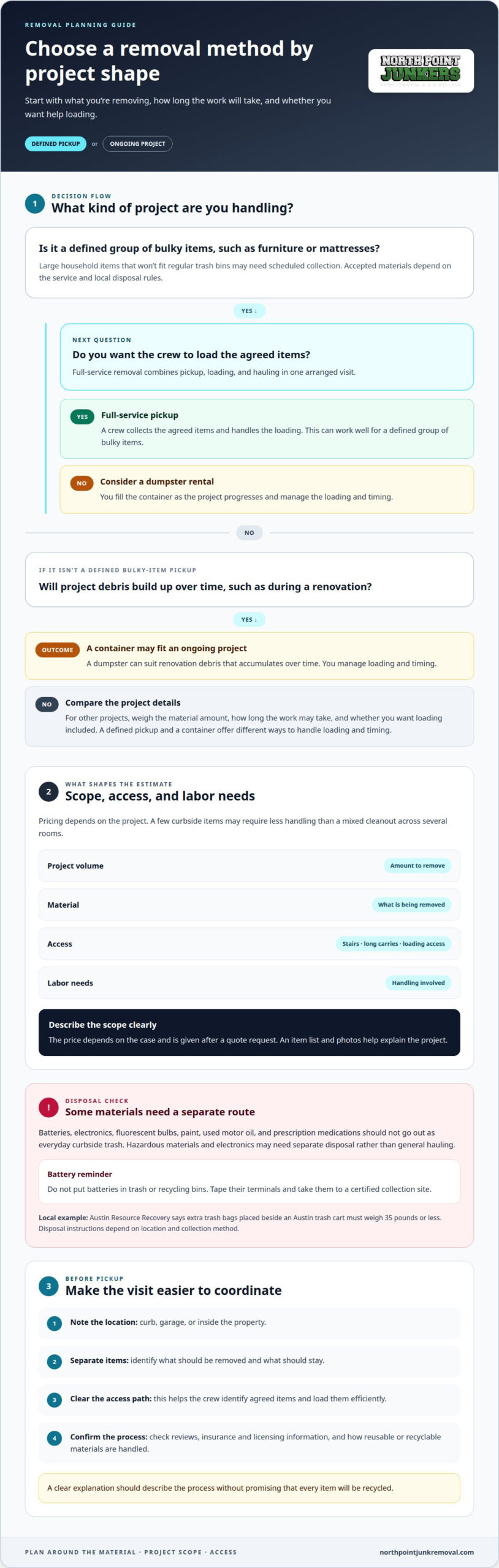
Full-service removal combines pickup, loading, and hauling in one arranged visit. The right option depends on the material, the project scope, and whether you want help loading.
Removal Versus Dumpster Rental
With full-service removal, a crew collects the agreed items and handles the loading. A dumpster rental gives you a container to fill as your project progresses, while you manage loading and timing. Consider the amount of material, how long the work may take, and whether you want loading included. A container can suit a renovation with ongoing debris; a pickup can work well for a defined group of bulky items.
Accepted Items and Special Disposal
Furniture, mattresses, and other large household items may need scheduled collection when they won’t fit regular trash bins. Accepted material depends on the collection service and local disposal rules. Batteries, electronics, fluorescent bulbs, paint, used motor oil, and prescription medications should not go out as everyday curbside trash. Batteries should not go in trash or recycling bins; tape their terminals and take them to a certified collection site.
Hazardous materials and electronics may need a separate disposal route rather than general hauling. Local rules also affect curbside collection. Extra trash bags placed beside an Austin trash cart must weigh 35 pounds or less, according to Austin Resource Recovery. This example shows why disposal instructions depend on the location and collection method.
Pricing Factors
Removal pricing depends on the project’s volume, material, access, and labor needs. A few items at curbside may require less handling than a mixed cleanout across several rooms. Stairs, long carries, and difficult loading access can also affect the work involved. The price depends on the case and is given after a quote request; a clear item list and photos help describe the scope.
Pickup Scheduling and Preparation
A professional pickup is planned around the items, their location, and the agreed scope. Note whether the material is at the curb, in a garage, or inside the property. Before the visit, separate items for removal from belongings that should stay, and clear the access path. This helps the crew identify the agreed items and load them efficiently.
When choosing a company, look for reviews that describe communication and completed work. Check its insurance and licensing information, and ask how it handles reusable or recyclable materials. A clear explanation should describe the process without promising that every item will be recycled.
Service for businesses and privately serviced residences
Commercial properties and privately serviced homes may have collection arrangements separate from municipal residential pickup. The provider, collection day, and accepted materials depend on the property’s service agreement and local arrangements. A storefront, office, apartment building, or privately serviced home should follow its own collection instructions rather than assume a nearby home’s schedule applies.
That distinction matters when coordinating routine trash and recycling. A business may need collection to fit its operating hours, delivery access, or service entrance. A privately serviced home may have a different pickup day from nearby properties. Before planning a cleanout or regular service, identify who handles each type of waste and where containers or items should go.
For a commercial collection plan, outline the property’s waste and access needs:
- Material: Separate ordinary trash, recyclables, and bulky items.
- Access: Note the loading area, gate, or service entrance.
- Timing: Record the agreed collection day and any site access limits.
- Changes: Flag a renovation, move, or seasonal cleanout.
These details help match collection arrangements and container needs to the property. A dumpster can suit renovation debris or a one-time cleanout, while scheduled collection handles ongoing waste. Keep loading areas accessible for staff and haulers. At a mixed-use property, describe each area separately, such as office waste, tenant recycling, and discarded furniture.
Recycling arrangements also depend on the property and collection service. Keep business recycling separate from public street litter containers, which serve a different purpose. The collection service can explain which materials belong in each stream. Separating cardboard, containers, and general trash makes the plan easier to follow when each has a distinct collection category.
For material beyond routine collection, describe the items, their location, and the project scope when arranging removal. Clearing unwanted furniture from a storefront differs from managing ongoing office waste. A dumpster can suit project debris that builds up over time, while a defined pickup can work for a one-time cleanout. Share access, timing, and material details so the removal plan fits the property without disrupting normal operations.
Businesses and privately serviced residences in San Diego should refer to a City-approved private franchise hauler or certified recyclable material collector. Before arranging service, confirm which provider is responsible for the property and what collection arrangements apply. Clarify accepted materials, container placement, pickup timing, and any access instructions. Keep those details together so staff, tenants, or household members can follow the same plan. If needs change during a cleanout or renovation, describe the materials and access conditions when discussing the service.
For a property with several occupants or uses, make instructions clear for each area and waste stream. Identify where routine trash, recycling, and project materials should be kept, and distinguish those arrangements from public street litter containers. If an item or load does not fit the normal collection plan, describe it before setting out materials. Clear communication helps prevent confusion with a nearby property’s service and supports a plan suited to the site. Keep the provider’s instructions where everyone responsible for waste handling can consult them, and update them when the service agreement or property needs change.
Trash container sizes and household recommendations
The right container capacity depends on household waste volume and collection frequency. A small household with limited packaging may need less space than a larger household that regularly discards bulky packaging. Notice how quickly the current cart fills between collection days. That pattern helps you discuss capacity or decide whether the overflow comes from a temporary project.
Before requesting more capacity, identify the size of the current cart and what fills it first. Food packaging, shipping boxes, and everyday household trash create different patterns. If the cart fills mainly after a move or room cleanout, the temporary surplus may need a separate plan. Recurring overflow points to a different issue than a single week of extra material.
Container fit involves more than capacity. Consider where the cart is stored, how it moves to the street, and whether its route stays clear. A cart may hold the household’s waste but still be awkward to move if the storage area is narrow or the path crosses steps. Note, for example, whether it must pass through a side gate or around parked vehicles. These details help distinguish a capacity concern from a placement problem.
- Track the pattern: Notice which household material fills the cart fastest.
- Separate the cause: Distinguish routine trash from a one-time cleanout.
- Review the space: Consider storage, access, and the route to the street.
- Match the solution: Use regular collection for ongoing waste and plan separately for bulky items.
Recycling capacity matters alongside trash space. Separate recyclable materials according to the property’s collection instructions. Batteries also need careful handling and should not go in trash or recycling bins. If recycling fills first, review what goes into each container before assuming the household needs more trash capacity. Sorting can show whether the issue is container size or how materials are separated.
A one-time surplus may not call for a larger everyday cart. Clearing a basement, preparing for a move, or removing old furniture creates different needs from managing regular packaging and bagged trash. For households tackling relocations alongside major cleanouts, full-service providers like trunationwidellc.com illustrate how pairing moving assistance with junk removal helps streamline bulky disposals. For a temporary cleanout, describe the items and their location when arranging removal. Keep routine curbside collection for everyday waste and plan separately for bulky household items. This matches the solution to the reason the cart is filling instead of treating every overflow as a lasting need.
What types of items do trash removal services accept?
Accepted items depend on the collection method and local disposal rules. A scheduled pickup can handle bulky household items that don’t fit regular trash bins. In Los Angeles, scheduled collection is available for furniture, mattresses, and other large household items. A full-service crew may also remove an agreed group of unwanted items from a home or business.
For a household cleanout, describe items by category and location. A couch in the living room differs from loose material across several rooms. A mattress, dining table, or other bulky piece may need separate handling from bagged household trash. For a business, examples might include discarded office furniture or items left after a space cleanout. Share the item list when arranging collection so the scope is clear.
Some items need a route separate from ordinary trash. Batteries, electronics, fluorescent bulbs, paint, used motor oil, and prescription medications should not go out as everyday curbside trash, according to WM. In Los Angeles, household hazardous waste accepted at S.A.F.E. Collection Centers includes paint, motor oil, propane tanks, and needles. These examples show why item type matters: a general removal pickup is not specialized hazardous-waste handling.
Small dead animals are covered by different local rules. In Austin, small animals such as mice, birds, or turtles may be bagged and placed in trash carts. That guidance applies to Austin trash carts, not every city or removal service. Follow local collection instructions for unusual materials.
- Bulky household goods: Identify furniture, mattresses, and other large pieces.
- Business cleanout material: Describe discarded items by room or work area.
- Restricted material: Separate batteries, electronics, chemicals, and medicines from ordinary trash.
- Unusual items: Use the local collection rules for items such as small dead animals.
Clear descriptions help distinguish a general junk pickup from a specialized disposal need. Include the item type, approximate quantity, and location, such as curbside, garage, office, or an upstairs room. For one bulky item, explain its size and access path. For a mixed cleanout, group similar materials in the description. A household junk removal pickup can suit ordinary unwanted belongings, while hazardous or restricted materials need their designated route. Keep batteries and electronics out of regular collection streams.
Los Angeles S.A.F.E. Collection Centers accept household hazardous waste such as paint, motor oil, propane tanks, and needles. Describe these as a separate category rather than including them in a general list of unwanted household goods. Identifying the category gives local disposal guidance a clear starting point. If a load contains ordinary belongings as well as one of these materials, name the hazardous item separately. These examples reflect Los Angeles collection-center guidance; they do not mean every removal service accepts the same materials or uses the same process. Follow the applicable local instructions before setting out or arranging pickup.
How do trash removal companies calculate pricing?
A removal estimate reflects the work required for a defined job. The amount and type of material matter, along with loading needs and access. A sofa beside a driveway presents a different task from a mixed cleanout spread across several rooms. The volume of material helps determine the estimate.
Volume helps describe how much space the material takes up. A few bulky pieces may occupy more room than many compact items. Weight and material type can also affect handling and disposal. For example, a pile of broken furniture differs from a collection of light cardboard boxes. Clear item descriptions help explain the job’s size.
Labor depends on where items are and how the crew can reach them. Curbside items may take less handling than belongings in an upstairs room. Stairs, narrow hallways, long carries, and limited loading access can change the work involved. A garage cleanout may require different effort from removing one accessible chair. Describe these details when requesting an estimate.
Scope matters too. An estimate for a few listed items may need updating if the removal expands to another room. Separate what should go from what should stay, then provide an accurate inventory. Photos help show the amount, item types, and access points. They also clarify whether the request covers one item or a larger cleanout.
- Volume: Describe how much material needs removal.
- Item type: Name bulky, heavy, or mixed materials.
- Access: Explain stairs, distance, gates, and loading location.
- Scope: Identify every area and item included in the job.
Disposal needs can affect handling and the removal plan. Everyday household goods differ from batteries, electronics, paint, and other restricted materials. Keep those items separate in your description. An estimate should reflect materials the requested service can handle, rather than assume every item follows the same disposal route.
The price depends on the case and is given after a quote request. Factors include volume, material, access, and labor needs. Provide a focused item list, useful photos, and the pickup location to describe the job clearly. If the project changes, update the scope before work begins. Request a removal estimate using the details that best represent your project.
North Point Junk Removal
North Point Junk Removal helps homeowners and businesses turn disposal questions into a clear removal plan. Contact the team when household items, commercial clutter, or a larger cleanout exceed routine curbside collection.
Residential and Commercial Junk Removal cover unwanted items from homes and workplaces. Hoarding Cleanup supports more involved cleanouts, while container rentals suit projects where you want a dedicated space for debris. Share the item types, pickup location, and project scope to help define the right approach.
For bulky items or mixed cleanout material, professional hauling can simplify the next step. For projects that need an on-site container, our reliable trash removal service offers a separate option. Contact North Point Junk Removal to discuss your removal needs.
Make room for the next stage
A planned removal can support a larger change, such as preparing a property for new occupants, clearing space for renovation, or resetting a work area. Treat the pickup as one part of that transition. Coordinating it with surrounding plans can help keep rooms, access points, and work schedules aligned.
A professional trash removal service can also make a difficult cleanout feel more manageable by giving the task a clear starting point. Choose the outcome you want from the space, then arrange removal around that priority. Whether you’re planning a home change or a business reset, the next step can be a straightforward conversation about the work.
Contact North Point Junk Removal to discuss your project and take the next step toward a clearer space.
You May Also Like

Attic Cleanout in Milton, GA: Pricing and Removal
The cost of an attic cleanout in Milton, GA depends on how much you need removed and how much truck space the items occupy. North Point Junk Removal…