
A polished star rating can hide the details that matter most. For local movers in Johns Creek, GA, reviews are useful when they describe the crew’s communication, care with belongings, and handling of problems, while credentials help confirm who you’re hiring. A local move is typically less than 50 miles and stays within the same state.
Look beyond the overall rating. Read recent reviews for specific, recurring details, and notice whether the company responds clearly to concerns. Then verify its business identity and credentials through reliable records instead of relying on advertising claims.
This guide explains how to read local movers Johns Creek GA reviews, spot useful patterns, and check credentials before choosing a mover. It also covers what to clarify about your move so you can compare companies based on service quality and fit, not just star ratings.
Key Takeaways
- Look for detailed, consistent review patterns about communication, care, and how concerns are handled, not just a high star rating.
- Use a mover’s business identity and credentials to check that the company’s public claims align with reliable records.
- A local move typically stays within the same state and covers less than 50 miles, which helps clarify what kind of move you’re arranging.
- Ask about parking, building access, and move-day procedures early; some Johns Creek communities require written HOA notice several weeks before a move.
- Plan separately for unwanted items: a cleanout or dumpster rental can help clear space before moving day.
Johns Creek mover reviews
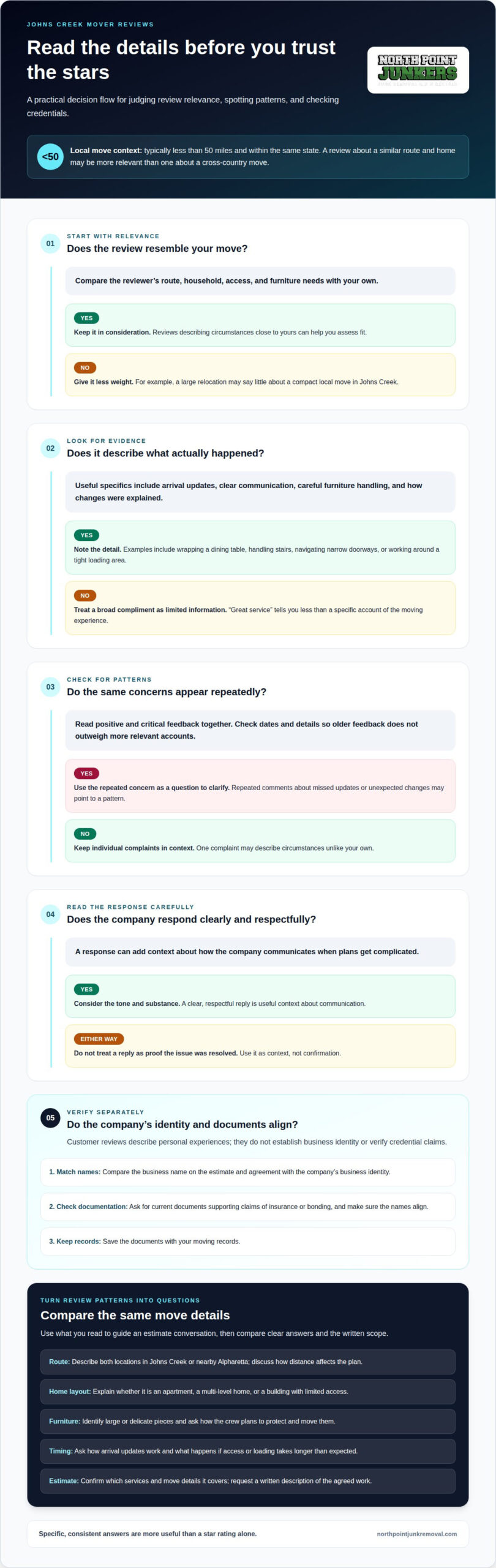
Reviews can show how a moving company handles the details that shape a relocation, from arrival updates to furniture protection. For a local move, the distance is typically less than 50 miles and the move stays within the same state. A Johns Creek review about a short trip across town may be more relevant than one about a cross-country distance move. Match each review to your route, home, and service needs before weighing its rating. Reviews for local movers in Johns Creek, GA, are most useful when they describe circumstances close to your own.
Start with the details, not the stars. A useful review describes what happened: whether the crew arrived as planned, communicated clearly, handled furniture carefully, and explained changes. For example, “the team wrapped the dining table and kept us updated during the move” gives you more to assess than “great service.” Look for details about the moving experience, such as handling stairs, narrow doorways, or a tight loading area. These specifics can help you judge whether the reviewer’s experience is relevant to your needs.
Read positive and critical feedback together. One complaint may describe circumstances unlike yours, while repeated comments about missed updates or unexpected changes may point to a pattern. Pay attention to the company’s response, too. A clear, respectful reply that addresses the concern can show how the company communicates when plans get complicated. Treat the response as context, not proof that the issue was resolved. Check the review date and details so older feedback doesn’t outweigh more relevant accounts.
Turn reviews into a practical checklist
Use reviews to identify details to clarify during an estimate conversation. Keep your questions tied to your move rather than asking broad questions that are hard to compare. For example, a review mentioning a difficult stairwell can prompt you to describe your entrance and ask how the crew would plan for it.
- Route: Describe both locations in Johns Creek or nearby Alpharetta, then discuss how distance affects the plan.
- Home layout: Explain whether you’re moving from an apartment, a multi-level home, or a building with limited access.
- Furniture: Identify large or delicate pieces and ask how the crew plans to protect and move them.
- Timing: Ask how arrival updates work and what happens if access or loading takes longer than expected.
- Estimate: Confirm which services and move details it covers, so the written scope reflects your conversation.
Compare the answers with the patterns you noticed in reviews. If reviewers mention advance communication, ask how the company shares updates. If they describe confusion about an estimate, request a written description of the agreed work. Before choosing local movers in Johns Creek, GA, look for clear, consistent answers about your route, access, and belongings. Comparing the same practical details makes it easier to assess your options than relying on star ratings alone.
Check credentials separately from customer feedback. Reviews describe personal experiences, but they don’t establish a company’s identity or verify its claims. Match the company name on its estimate and agreement to its business identity. Ask for current documentation supporting claims of insurance or bonding, and make sure the names align. Keep the documents with your moving records. These steps help you assess credential claims without treating online comments as formal proof.
Finally, judge how relevant each review is to your move. A review about a large relocation from Alpharetta may say little about a compact local move in Johns Creek. Look for accounts similar to your household, route, access, and furniture needs. A brief, specific review can be more useful than a long account with few details. Use what you learn to discuss your move, plan it, and understand what the estimate covers before scheduling.
Are there parking, building, or HOA rules that affect moving in Johns Creek?
Yes. A Johns Creek move can involve property-specific parking, access, and scheduling rules, particularly in managed communities. Some Johns Creek communities require written notice to the HOA several weeks before a move. Include that notice in your plan early, since it may affect your moving date.
Start with the property at each end of the move. Moving from a townhome to an apartment may mean following two different sets of instructions. The pickup property might limit where a moving truck can park, while the destination building may require a service entrance or loading area. Record the contact person, approved access point, and move-day instructions for both addresses.
Parking affects the route between the truck and your door. A truck parked far from the entrance means a longer carry for boxes and furniture. A blocked driveway, narrow guest parking area, or reserved space can complicate loading, too. Describe the available parking to the moving crew, including whether a truck can reach the building entrance. If a space needs to remain open, arrange it before moving day.
Ask about access and building procedures
For a managed building, ask the property manager about its move-in and move-out procedures. Clarify whether residents reserve an elevator, use a loading dock, protect hallway floors, or follow set move hours. These are planning prompts, not universal Johns Creek rules. Record the building’s actual instructions and share them with everyone involved in the move.
A gated community adds another access step. Confirm how the crew enters, where visitors should report, and whether the resident must provide entry instructions in advance. For example, a crew arriving at a staffed gate needs clear directions to the home and parking area. Include the community name and best entrance in your move plan so the driver can find the right route.
Give HOA notice early. Some communities require written notice several weeks before a move, so note the deadline as soon as you choose a date. Ask what the notice must include, such as the date, expected arrival window, or truck details. Submit it using the HOA’s stated process and keep a copy with your moving documents. A written record helps you track what you submitted and when.
Use this short checklist for each address:
- Parking: Identify the truck’s planned location and any reserved or restricted spaces.
- Building access: Record entrances, elevator procedures, loading areas, and permitted move hours.
- Community entry: Provide gate instructions and the correct property contact.
- HOA notice: Set a reminder for the written notice deadline, which may fall several weeks before the move.
- Communication: Share the final instructions with the household and moving crew before moving day.
The City of Johns Creek provides new-resident information about trash pickup, utilities, and permits. This can help you organize a household transition, while parking and building procedures depend on the property. Keep the tasks separate: use city information for municipal services and the HOA or building’s instructions for access to its grounds.
Removing unwanted household items before the truck arrives can also free up rooms and clear walkways. A moving cleanout can help prepare a home for a more organized loading day. Keep parking, access, and HOA steps on the same calendar, then share the final plan with everyone involved.
Before confirming the plan, translate access limits into time and budget questions. Moving Help advises adding 1 hour for each flight of stairs when estimating moving time, so tell the estimator about stairs at both properties and ask how that affects the schedule. If parking or building access could delay loading, clarify how waiting time is handled.
If the truck cannot reach the approved entrance, ask whether temporary storage is available and what charges may apply. For moves that cross a substantial distance, confirm how the company classifies the job: a long-distance move is generally considered to be 400 miles or more, although definitions vary among moving companies. Clarifying these details alongside the property rules can help you compare estimates and avoid surprises on moving day.
North Point Junk Removal
North Point Junk Removal can clear unwanted items before or after your Johns Creek move, making rooms and access paths easier to manage. Residential Junk Removal handles household items you don’t want to transport, while Commercial Junk Removal can help prepare a workplace for relocation. For a larger cleanout, Dumpster Rentals offer another way to manage the project. Hoarding Clean-up is available when a home needs a more specialized, considerate cleanout.
Plan the cleanout around your moving schedule: identify what should go, what you’re keeping, and which areas need clearing first. This can help separate removal work from packing and loading. If unwanted items are complicating your move, contact North Point Junk Removal to discuss your cleanout needs.
Make room for what comes next
Use your move as a chance to decide what deserves space in your next home or workplace. Set aside the belongings you’re taking, then identify unwanted items that would make packing or settling in harder. If you’re comparing local movers in Johns Creek, GA, plan junk removal separately from the move so each task has a clear purpose.
North Point Junk Removal offers Residential Junk Removal for household items, Commercial Junk Removal for workplace cleanouts, and Hoarding Clean-up when a home needs more focused support. Choose the service that fits the space and items to be removed. Arrange your cleanout before moving day by booking service online or requesting a free estimate using photos.
Contact North Point Junk Removal to discuss your cleanout and take the next step toward a more manageable move.