
Roof area alone won’t tell you whether a dumpster will work for a shingle tear-off. A dumpster for roofing shingles in Gainesville, GA gives the crew a central place for heavy debris and avoids repeated trips hauling it away. The right size depends on shingle type, roof pitch, layers, and whether decking is included.
It’s sensible to weigh both capacity and hauling costs before the tear-off begins. This guide explains how shingle weight affects dumpster size, what roof details can change the estimate, and how placement and landfill fees factor into the plan. You’ll also see where the available 10-, 15-, and 20-yard sizes may fit, so you can make a clearer decision for your project.
Key Takeaways
- Choose a dumpster by debris weight as well as roof area; shingles, underlayment, nails, and other tear-off materials all contribute to the load.
- Account for every shingle layer and the roof pitch when estimating capacity, since either can increase the amount of debris.
- Plan placement around site access and surface protection, and account for local requirements if the container will sit on the street.
- Separate landfill hauling costs from rental costs, and understand how Hall County’s weight-based tipping fees affect the total.
- North Point Junk Removal offers dumpster rentals for roofing projects, with 10-, 15-, and 20-yard sizes available.
Can roofing dumpsters handle the weight of shingles?
Yes, a dumpster can hold roofing shingles when the rental’s weight allowance suits the load. Distribute shingles evenly, keep debris within the container, and secure loose material before pickup.
Accounting for Roofing Debris Weight
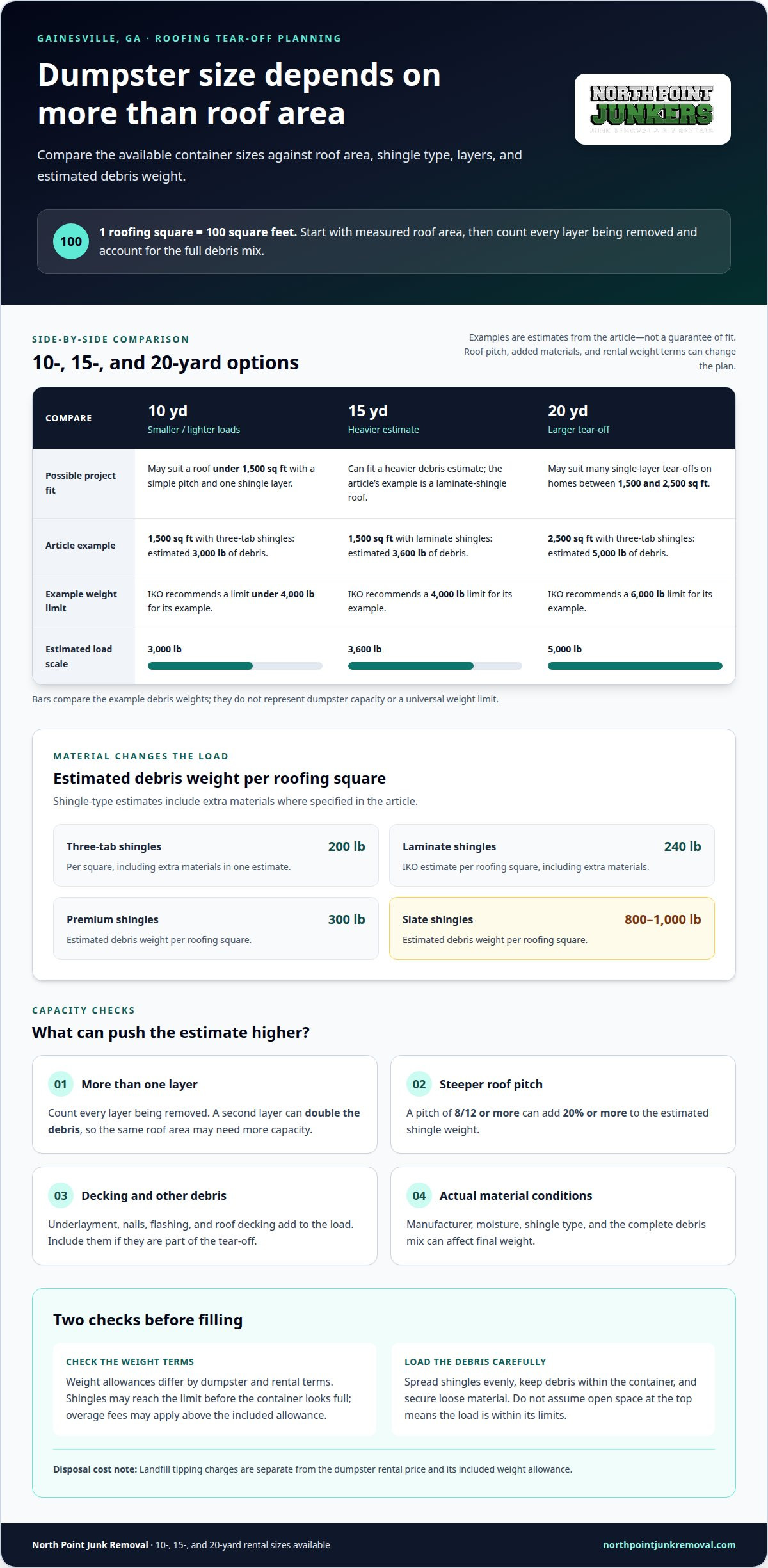
Shingle type changes the estimate: asphalt shingles, laminate, premium shingles, and slate can weigh very differently. One estimate puts three-tab shingle debris at 200 pounds per roofing square, including extra materials. For a separate estimate, add 10 pounds per square for underlayment, nails, and other debris. A roofing square covers 100 square feet.
IKO estimates laminate shingle debris at 240 pounds per roofing square, including extra materials. Premium shingle debris is estimated at 300 pounds per square, while slate shingles can weigh 800-1,000 pounds per square. Manufacturer, moisture, underlayment, flashing, nails, and roof pitch all affect the final weight. A steep roof with a pitch of 8/12 or more can add 20% or more to the estimated shingle weight.
Understanding Weight Allowances and Limits
A dumpster’s weight allowance is the amount of debris included in its rental terms. Shingles can reach that limit before the container looks full, so estimate weight as well as volume. Roof decking and underlayment can go in with shingles, but both add weight. The rental terms and complete debris mix determine how much material fits in one load.
Loads above a dumpster’s included allowance may incur overage fees. Don’t assume that open space at the top means more shingles can be added safely. Keep debris within the container’s limits, accounting for multiple shingle layers, flashing, nails, and decking. Heavier materials, such as slate, can substantially change the weight estimate.
Landfill tipping charges are separate from a dumpster’s weight allowance. These fees apply to landfill disposal, not the rental price of a dumpster.
Before removal, identify the shingle type and count the layers being torn off. Include underlayment, nails, and any decking in your debris estimate. Asphalt shingles may weigh less than slate, but a second layer or steep pitch can add substantially to the total. Contain loose material and spread debris across the dumpster instead of piling it in one spot.
These estimates help frame the load, but weight allowances differ by dumpster. A 10-yard, 15-yard, or 20-yard container can have different limits depending on its rental terms. Compare the estimated debris weight with the applicable allowance before filling the container. That check helps avoid an unexpectedly heavy load and keeps disposal planning tied to the actual roof materials.
Choosing a dumpster size for roof square footage and shingle layers
Roof area is a starting point, but shingle layers, material type, and debris weight also affect container choice. Estimate the full tear-off load before choosing capacity, especially if older layers lie beneath the visible shingles.
Matching Capacity to Roof Size
Start with the roof’s measured area and count every layer being removed. Most residential roofs cover 20 to 40 squares, and one roofing square covers 100 square feet. A second layer can double the debris, so the same roof area may require more capacity after a layered tear-off.
IKO estimates that a 1,500-square-foot roof with three-tab shingles produces 3,000 pounds of debris. Its example recommends a 10-yard dumpster with a weight limit under 4,000 pounds. Roof pitch and added materials can change the estimate, so include decking and underlayment in the projected load.
Comparing Dumpster Size Options
A 10-yard container may suit a smaller roof under 1,500 square feet with a simple pitch and one shingle layer. A 15-yard size can fit a heavier debris estimate. For example, IKO estimates 3,600 pounds from a 1,500-square-foot laminate-shingle roof and recommends a 15-yard dumpster with a 4,000-pound weight limit.
A 20-yard dumpster may suit many single-layer tear-offs on homes between 1,500 and 2,500 square feet. IKO estimates 5,000 pounds for a 2,500-square-foot three-tab roof and recommends a 20-yard dumpster with a 6,000-pound limit. In Gainesville, available rental sizes include 10, 15, and 20 yards.
Considering Shingle Disposal Alternatives
Self-hauling is an alternative to dumpster rental. Hall County roofing shingles are accepted only at the Hall County Landfill, not at compactor sites or the recycling center. The landfill accepts waste generated in Hall County, so the debris’s origin determines whether this option works.
Self-hauling means arranging transport, loading a vehicle or trailer, and taking the shingles to the landfill. Consider debris volume and weight before choosing this option. A small repair may be easier to transport than a full tear-off, especially if the project includes several shingle layers or other roofing materials.
Finding Roofing Debris Rental Providers
For Gainesville roofing work, look for rental options that match both the debris volume and the load’s weight. A container can have room left while nearing its weight limit, so consider both measures when comparing sizes. The available 10-, 15-, and 20-yard options provide different capacities for roofing projects.
Estimate the roof area, identify the shingle type, and count the layers planned for removal. Then account for decking and underlayment if they’re part of the tear-off. These details help shape a useful rental plan before the roofing crew starts loading debris. Discuss your roofing debris needs to plan the next step.
Dumpster placement and customer property
Choose a placement that gives the delivery vehicle clear access and keeps roofing debris close to the work area. In Gainesville, driveway and street placements have different permit considerations.
Checking Access in Tight Lots
On a tight lot, map the container’s route from the road to its intended spot. Check for gates, parked cars, low branches, and other obstacles. A driveway that looks open from the street may still have a narrow turn or blocked approach.
Pick a location that makes loading shingles and underlayment practical without blocking essential access. For example, placing the container near the tear-off area can shorten the distance workers carry debris. Clear the route of construction materials and household vehicles before delivery. Container size and shape also affect placement, particularly where a driveway or access lane is tight.
Consider the surface, too. A loaded container can put pressure on the ground beneath it, so factor in the driveway’s material and condition. If the surface is delicate or uneven, discuss placement options before delivery. A curbside spot may avoid a tight driveway, but it can leave the container farther from the roof and change how debris is loaded.
Reviewing Placement and Permit Needs
A dumpster placed in a Gainesville driveway typically doesn’t require a permit. Street placement is different: check current requirements with the City of Gainesville before scheduling delivery. Don’t assume a driveway rule also applies at the curb.
Before choosing a street location, identify where the container would sit and whether it would interfere with traffic or access. The City’s current requirements govern street placement, while the property layout determines whether a driveway is workable. Plan ahead so the roofing crew has a designated place for debris from the start.
Use a short placement checklist before delivery:
- Clear the driveway or the chosen access route of vehicles and construction supplies.
- Point out gates, low branches, narrow turns, and surface concerns.
- Choose a spot that supports loading without blocking the work area.
- For street placement in Gainesville, review the City’s current requirements first.
Planning matters during a roof replacement because shingles, nails, and underlayment can spread beyond the tear-off area. A central container defines the disposal point and helps keep loose debris contained around the property. If the driveway doesn’t provide suitable access, a curbside location may be an alternative, subject to Gainesville’s street-placement requirements. Consider both the delivery route and the crew’s loading path.
Estimated dumpster sizes by roof area and shingle type
A home’s listed square footage is not the same as its roof’s actual surface area. For a dumpster for roofing shingles in Gainesville, GA, start with roof measurements, then account for pitch, shingle type, and layers. These details help distinguish a small repair from a full replacement and estimate the debris.
One roofing square covers 100 square feet. A calculator using a standard 6/12 roof pitch factor estimates the roof surface from its footprint, but the actual pitch changes the surface area. A roof’s shape also matters: valleys, dormers, and connected sections can make a simple footprint estimate less useful. Use measured roof planes when available, rather than relying only on the home’s floor area.
Shingle type turns area into a weight estimate. The research figures estimate three-tab debris at 200 pounds per roofing square, including extra materials. Multiply the estimated roof squares by the appropriate debris weight, then consider whether the project includes underlayment or decking.
Layers matter just as much as surface area. A tear-off with two shingle layers produces more debris than a one-layer replacement covering the same roof. For a roof with 3,500 square feet or more, IKO estimates at least 10,500 pounds of debris from premium shingles and says multiple dumpsters are required. IKO also advises multiple dumpsters for laminate shingle reroofing jobs at 3,500 square feet or more.
Use these steps to estimate the load before choosing a container:
- Measure each roof plane and add the areas together.
- Convert total square feet into roofing squares by dividing by 100.
- Identify shingle type and count every layer being removed.
- Include other material, such as underlayment or roof decking.
- Compare the resulting debris estimate with container capacity and weight allowance.
A repair may involve one roof section, while a full replacement can cover every plane. If debris removal is limited to one section, estimate that area rather than the entire roof. A small patch, for example, won’t create the same load as stripping every roof plane on the same house.
Finally, use the estimate to choose between a 10-, 15-, or 20-yard container based on both volume and weight. For a dumpster for roofing shingles in Gainesville, GA, a larger roof, premium shingles, steep pitch, or multiple layers can shift the choice upward. If the calculated load exceeds one container’s capacity, plan for multiple containers rather than relying on unused space alone.
Costs of hauling roofing debris to a landfill
Landfill hauling costs depend on load weight, travel, and transportation. In Gainesville, Hall County’s landfill tipping fee is weight-based, while a dumpster rental typically consolidates disposal into one removal. Keep these costs distinct when planning: landfill charges apply to waste disposal, while rental costs depend on the container and service terms.
A heavy shingle tear-off can reach the landfill’s tipping threshold quickly, especially when the load includes multiple layers, underlayment, or roof decking. The scale weight, not the container’s visible fill level, determines the landfill charge.
Hall County roofing shingles are accepted only at the Hall County Landfill, not at compactor sites or the recycling center. The landfill accepts waste generated in Hall County, so the debris source affects whether this disposal route fits. Its location is 1700 Oakbrook Drive in Gainesville. Account for the trip from the job site, unloading, and return travel when planning a self-haul.
Transport also carries costs beyond the tipping fee. A round trip can take at least 2½ hours. Those hours and vehicle costs add up when a crew makes two or three landfill trips per week.
A dumpster can consolidate roofing debris for disposal and avoid repeated trips. Rental terms typically include disposal, while self-hauling separates the landfill charge from fuel, vehicle wear, and labor. Compare the complete disposal plan, not just the scale fee. The best fit depends on debris volume, load weight, distance to Hall County Landfill, and the trips the job would otherwise require.
- Estimate the load weight, including shingles and other tear-off materials.
- Use the Hall County Landfill tipping schedule to understand weight-based charges.
- Include travel time, vehicle wear, and crew wages when considering self-hauling.
- Account for the county origin of the waste and the landfill’s location.
For example, a roofing crew hauling several loads must account for each landfill trip’s time and vehicle use, as well as the tipping fee. One consolidated disposal trip may simplify logistics, while a small repair may produce a load that’s easier to transport directly. Choose based on the debris and travel involved.
North Point Junk Removal: Dumpster Rentals
North Point Junk Removal offers dumpster rentals for roofing projects that need a designated place for tear-off debris. Its 10-, 15-, and 20-yard dumpsters provide size options to consider alongside roof area, shingle layers, and estimated load weight.
A rental can suit a full replacement when shingles and other roofing debris need to be gathered on-site. For smaller cleanups or jobs where a container isn’t the right fit, North Point Junk Removal also provides residential and commercial junk removal.
Before choosing a container, note the roof area, shingle type, number of layers, and whether the job includes underlayment or decking. These details help estimate the space and weight needed. Contact North Point Junk Removal to discuss your roofing debris project.
Set Up Your Roofing Cleanup Plan
Before tear-off begins, turn your roof estimate into a simple debris plan. Decide what materials the crew will remove, where debris will collect, and how it will leave the property. Planning ahead keeps cleanup connected to the roofing work instead of leaving it as a separate project at the end.
Choosing a dumpster for roofing shingles in Gainesville, GA starts with the needs of the specific job. North Point Junk Removal offers dumpster rentals, along with residential junk removal, hoarding cleanup, and commercial junk removal for other cleanup needs.
Share the project details that shape your disposal plan, such as the roof area, shingle layers, and other materials being removed. A clear starting point makes it easier to discuss the right next step for your property. Contact North Point Junk Removal to talk through your roofing cleanup. With a workable plan in place, you can focus on the roof and keep the debris process moving forward.
Frequently Asked Questions
Can I mix old plywood decking in with the shingles?
Yes, roof decking can go in the same dumpster as shingles, but plywood adds weight. Include decking in your estimate rather than calculating capacity from shingles alone. A tear-off with damaged sheathing, for example, needs more weight allowance than shingles from the same roof by themselves. Keep both materials within the container’s fill and weight limits.
Do you deliver roofing dumpsters same day for storm damage?
Don’t assume same-day dumpster delivery for storm damage. North Point Junk Removal offers same-day junk removal pickup. For a storm-damaged roof, plan where debris will go and coordinate the roofing work with the container’s delivery timing. Keep loose shingles and other materials contained while waiting to prevent wind from scattering debris across the property or nearby driveways.
What size dumpster do I need for a roof tear-off?
The right size depends on the roof’s area, shingle type, number of layers, and any decking included. Available options are 10-, 15-, and 20-yard dumpsters. A small, single-layer tear-off may fit a smaller container, while heavier materials or multiple layers can require more capacity. Estimate both debris volume and total weight before choosing, since shingles can reach a container’s weight limit before it looks full.
How many squares of shingles fit in each dumpster size?
There isn’t one reliable square count for each dumpster size because shingle weight and layers change the load. One roofing square covers 100 square feet, but that measurement describes roof area, not container capacity. Convert the roof area into squares, identify the shingle type, then account for extra layers and materials. A 10-, 15-, or 20-yard container must be assessed by both its volume and weight allowance.
What are the weight limits and overage fees for shingle dumpsters in Gainesville, GA?
Weight limits and overage fees depend on the dumpster’s rental terms, so don’t mistake the landfill tipping threshold for a container allowance. That threshold is a landfill charge, not a rental overage fee. Shingle type, layers, decking, and underlayment all affect load weight.
What permits are required to place a dumpster on a street or public property in Gainesville, GA?
For street placement in Gainesville, check current requirements with the City of Gainesville before delivery. Driveway placement typically doesn’t require a permit, but that doesn’t determine the rules for a public street or other public property. Decide whether the container will sit on private property or the street before scheduling, then follow the City’s current requirements for that location.
Can shingles be mixed with other roofing materials in a rental dumpster?
Roofing dumpsters can accommodate asphalt shingles, metal roofing panels, tiles, wood, and insulation. Mixing materials may change the load’s weight and volume, so include every material in your estimate. A container holding shingles and removed insulation, for example, fills differently from one holding shingles alone. Keep debris within the dumpster and account for all tear-off materials when planning disposal.
You May Also Like
Construction Debris Dumpster Rental in Suwanee, GA
The right dumpster size is a project decision, not a guess. For construction debris dumpster rental in Suwanee, the available options include 10-,…
Dumpster Size for a Milton Garage Cleanout by Debris
A small garage cleanout doesn’t automatically need a large dumpster. If you’re deciding what size dumpster to use for a garage cleanout in Milton, a…
Driveway Safe Dumpsters in Forsyth County: Sizes and Permits
A dumpster on a private driveway or yard in Forsyth County generally doesn’t require a county permit; placing one on a public street or right-of-way…