
What if the right dumpster size depends less on the name of your project and more on what you’re tossing, how much it weighs, and where the container can go? A 20 yard dumpster rental can make an on-site cleanup easier, but choosing one that’s too small can disrupt the work, while a larger size may not be practical for your debris or placement area.
If you’re clearing out a home, tackling a renovation, or managing another debris-heavy project in Cumming, you may have questions about capacity, placement, and what can go in the container. North Point Junk Removal offers 20-yard dumpster rentals for customers who want to load debris on-site at their own pace.
This guide explains how to compare your project debris with a practical dumpster size, prepare a safe and accessible placement area, and organize a rental in Cumming, Forsyth County, and nearby communities. You’ll also learn what to consider about materials and site access so you can plan with less uncertainty and keep your project moving.
Key Takeaways
- A 20 yard dumpster rental can suit cleanouts and moderate renovation projects, depending on the debris and how much you need to discard.
- Estimate your load by listing materials, gauging their volume, and considering how bulky items stack with loose debris.
- Compare 10-, 15-, and 20-yard options by project scale. Treat examples as planning guidance, not a substitute for container specifications.
- Plan for a level placement area, overhead clearance, and clear access. Move vehicles and consider protecting nearby surfaces.
- North Point Junk Removal offers 20-yard rentals for customers in Cumming and nearby communities who want to load project debris on-site.
What Can a 20-Yard Dumpster Rental Handle in Cumming?
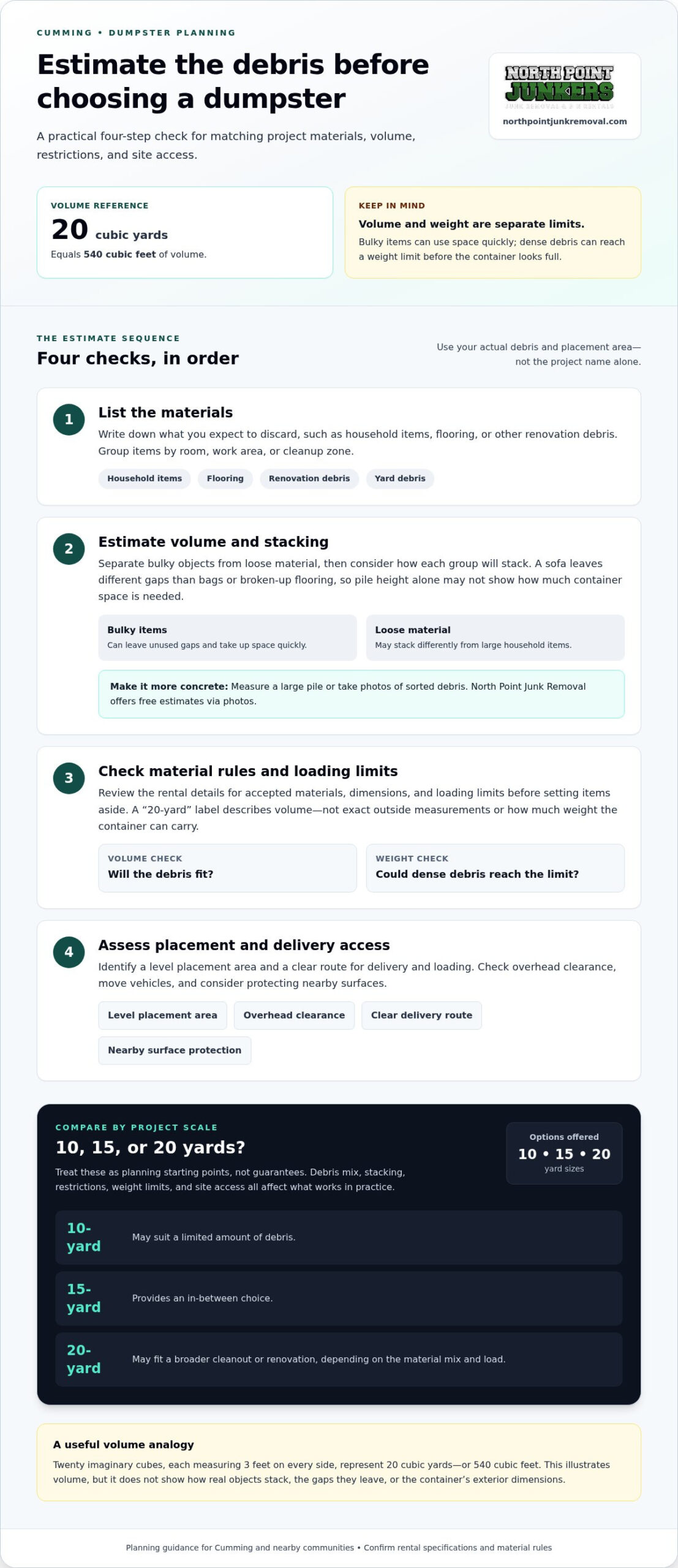
A 20-yard roll-off is named for its volume capacity, not a standard set of outside measurements. That makes the size a useful starting point, but not a guarantee that every project with the same label will fit. The debris mix, how items are packed, and the container’s specifications all affect usable space. A Roll-off (dumpster) is delivered to a site and filled there, making it a practical option when you want to manage loading on-site.
Quotable takeaway: “Cubic yards describe a dumpster’s volume, not its exact dimensions or the weight it can carry.” Volume and weight are separate limits. Bulky, light items may use up space quickly, while dense debris can reach a weight limit before the container looks full. Review the rental details for dimensions, loading limits, and material rules before planning your load. North Point Junk Removal offers 20-yard dumpster rentals in Cumming and nearby communities.
Which home projects may suit a 20-yard dumpster?
Garage, basement, and attic cleanouts are possible uses, particularly when the debris includes a mix of boxes, furniture, and household items. Moderate renovation work may also suit this size, with flooring, cabinetry, or drywall as examples, subject to accepted-material rules. Yard cleanup may be another fit if the debris type and volume work for the container. These are planning examples, not guarantees of fit.
Consider the whole project, not just its largest item. A garage cleanout with a few bulky pieces loads differently from one with many loose bags and small items. Renovation debris can also vary: even work limited to one room may produce dense or unusually bulky material that calls for a different plan.
What does 20 cubic yards mean in practical terms?
Volume analogy: Picture twenty imaginary cubes, each measuring 3 feet on every side. Together, they represent 20 cubic yards of volume, or 540 cubic feet. This illustrates the measurement, but it doesn’t show how a real load will stack or how irregular objects leave unused gaps. It also doesn’t tell you the container’s exterior size.
Length, width, and height can vary, so don’t estimate driveway fit or loading access from the “20-yard” label alone. Review the rental’s actual dimensions and loading limits, then compare them with your debris and placement area. To make a closer estimate, sort the project into broad material groups and note which items are bulky, loose, or dense. That gives you a more useful basis for deciding whether this size is practical.
How to Estimate Whether Your Project Needs a 20-Yard Dumpster
Start with the debris, not the dumpster label. A clear estimate helps you decide whether a 20 yard dumpster rental is a practical match or whether a smaller or larger option makes more sense. Use this sequence:
- List the materials. Note what you expect to discard, such as household items, flooring, or other renovation debris.
- Estimate the volume. Group items by room, work area, or cleanup zone, and consider how they’ll stack.
- Review item restrictions. Check the rental details for accepted materials and loading rules before setting items aside.
- Assess site access. Consider where the container could sit and whether there’s a clear route for delivery and loading.
Project volume and debris weight are separate sizing checks. Bulky items can use up space while remaining relatively light. Dense debris may approach a weight limit before it fills the container by volume. Review both the container’s loading limits and the materials you plan to put inside.
Estimate debris volume before choosing a size
Break the project into zones, such as a basement storage area, a kitchen renovation, or a section of yard. List the debris in each zone, then separate bulky objects from loose material. A sofa leaves different gaps than bags or broken-up flooring, so the height of a pile won’t always tell you how much container space it needs.
Make the estimate more concrete by measuring a large pile or taking photos of sorted debris. North Point Junk Removal offers free estimates via photos, which can help you describe the project before choosing a size. For renovation debris, the EPA’s Sustainable Management of Construction and Demolition Materials resource offers context on managing materials from building and remodeling work.
When could a smaller or larger dumpster make more sense?
A 10-yard option may suit a limited amount of debris, while a 15-yard container provides an in-between choice. A 20-yard size may fit a broader cleanout or renovation, depending on the material mix and load. These are starting points, not guarantees. Stacking, item restrictions, and weight limits can all affect what works in practice.
North Point offers 10-, 15-, and 20-yard dumpster options for projects in Cumming and nearby communities. Compare your zone-by-zone list with the rental details, then share photos of the debris when requesting a free estimate. If your list grows or includes dense materials, reassess before loading rather than relying on volume alone.
20-Yard Dumpster vs. Other Sizes: Compare the Project, Not Just the Number
A size label is a starting point, not a verdict. North Point offers 10-, 15-, and 20-yard dumpsters, so you can compare options by the scale and mix of your project. The examples below are planning guidance only. Container specifications and loading rules vary, and dense materials or limited site access can affect which option is practical.
| Option | Illustrative project scale | What to consider |
|---|---|---|
| 10-yard | A limited cleanout or debris from one small work area | Could suit a contained project with a modest amount of material. |
| 15-yard | A larger single-area cleanup or debris from more than one small area | Consider how bulky items and loose material will stack together. |
| 20-yard | A broader cleanout or renovation debris from multiple areas | Review the material mix, weight limits, and placement access. |
These examples aren’t volume guarantees. A one-room cleanout might produce little debris or more than expected, depending on what’s stored there. A multi-area cleanout may include furniture, boxes, and loose household items that use space differently. Renovation debris varies too: lightweight material doesn’t load like dense flooring or other heavy items. Compare what you’re removing, not just the number of rooms involved.
What separates a 10-, 15-, and 20-yard project?
Think in terms of scope. A 10-yard option may be a reasonable starting point for a limited cleanup. A 15-yard option provides a middle choice for a project that extends beyond one small area. A 20-yard dumpster rental may suit a wider-ranging cleanout or renovation. These are relative comparisons, not promises of fit. Compare the available sizes with your debris list. If heavy materials are involved, weight may matter before the container looks full.
Access matters, too. A larger container may not be the most practical choice if the placement area or delivery route is constrained. For local information about recycling and solid waste resources, consult Forsyth County Recycling & Solid Waste.
When is full-service junk removal a different fit?
Renting a container works well when you want to load debris yourself and manage the project at your own pace. Junk removal is a different option if you’d rather have a team remove items from the property. Choose based on how much material you have, how much loading work you want to take on, and the pace that suits your project. North Point provides both dumpster rentals and junk removal, including residential, commercial, and single-item removal.
Prepare a Safe, Accessible Dumpster Placement in Cumming and Forsyth County
A good placement plan starts before delivery. Choose a level, stable area with room for the container and a clear approach for the delivery vehicle. Think beyond the spot itself: overhead wires, tree branches, fences, parked cars, and narrow turns can all affect access. The required clearance depends on the delivery vehicle and container, so don’t guess based on the container’s name or yard size.
In Cumming and Forsyth County, placement requirements can depend on the exact location and whether the container would sit on private property or a public street or right-of-way. Property association rules may also apply. Review current requirements with the appropriate city or county office and your HOA, if applicable, before arranging placement. Don’t assume a rule for one property applies to another.
Check driveway access and the delivery area
Walk the full route from the street to the proposed drop-off area. Check gate width, turning room, slope, overhead wires, low branches, and nearby vehicles or other obstacles. A driveway that looks open from the house may still have a tight turn or limited clearance at the entrance. Clear the selected area before delivery and move vehicles that could block access.
Choose a firm, stable surface where the container won’t obstruct normal access. If you’re concerned about the driveway or another surface, consider protective materials where appropriate. They may help reduce direct contact, but they can’t guarantee that a surface won’t be marked or affected.
Plan loading around materials and safety
Before loading, review the rental terms for accepted materials, prohibited items, weight restrictions, and fill-line instructions. Rules can vary, so don’t assume a material is acceptable just because it fits inside the container. Keep debris below the marked fill line when one is provided, and load carefully so material stays contained rather than sticking out or shifting.
- Keep access clear. Leave a safe path to the container and avoid blocking doors, walkways, or vehicle routes.
- Load with care. Place items securely and avoid climbing into or standing on the container.
- Separate questionable materials. Set aside anything whose acceptance is unclear until you’ve reviewed the rental rules.
- Reassess as you go. Depending on the debris, a load can reach its weight limit before it reaches the top.
For a 20 yard dumpster rental, photos of the project debris and intended placement area can help you plan the setup. Gather your project details and request a dumpster rental estimate from North Point Junk Removal.
Arrange a 20-Yard Dumpster Rental with North Point Junk Removal
Once you’ve compared your debris with the container size and thought through placement, organize the rental details. North Point Junk Removal offers 20-yard dumpsters in Cumming, Forsyth County, and nearby communities. It’s an on-site option for customers who want to load project debris themselves and work at their own pace.
Use these steps to prepare:
- Describe the project. Share what you’re cleaning out or renovating and where the work is taking place.
- Summarize the debris. Group materials by type and estimate the amount as clearly as you can.
- Select a size. Compare the project scope with the 10-, 15-, and 20-yard options.
- Plan placement. Identify the intended drop-off area and note access constraints or nearby obstacles.
- Coordinate rental details. Review accepted-material rules, loading limits, rental terms, and pickup arrangements.
To compare sizes and take the next step, choose a dumpster rental option. Sharing clear project information at the start helps make the planning conversation more useful and keeps key details together.
What information helps plan the rental?
Prepare a brief project summary before requesting an estimate. Include the project type, main debris categories, your best estimate of the amount, and the area where you expect the dumpster to sit. Clear photos add useful context, especially if debris is spread across several rooms or includes bulky items. North Point offers free estimates via photos to help customers plan its services.
Photos work best when they show the full pile or area, not just a close-up of one item. If materials are in different locations, take separate pictures and label them by room or work area. This makes it easier to describe the project without guessing at measurements or overlooking debris stored out of sight.
What happens after the dumpster is in place?
Load steadily and distribute debris across the container rather than building one tall pile at one end. Follow the fill line and weight limits in your rental details, and keep materials within the container. Stay within the accepted-item rules as you work. If your debris changes or you’re unsure about an item, pause and review the rental terms before adding it.
Follow the pickup arrangements agreed upon for your project. Keep those details handy so you can plan your loading pace and know what arrangements apply once you’re finished. Preparation helps you make the most of an on-site rental without turning the process into a last-minute scramble.
If a dumpster fits your project, plan a local 20 yard dumpster rental with North Point and take the next step at a pace that works for you.
Take the Next Step Toward a Clearer Project Plan
A well-planned cleanup starts with a choice that fits how you want to work. If you’re ready to load debris on-site at your own pace, a 20 yard dumpster rental can give your project a practical place to start. North Point Junk Removal is locally owned and operated, serving Cumming and surrounding communities, including Alpharetta, Johns Creek, Milton, Suwanee, Sugar Hill, Buford, Dawsonville, Roswell, Gainesville, Oakwood, FloweryDuluth, Coal Mountain, Chestatee, Silver City, and Free Home, as well as Forsyth County.
You don’t need every detail figured out before taking the next step. Gather a few photos, note the general project scope, and describe what you’re hoping to clear. Free photo estimates are available for North Point’s services, helping you start with useful project context.
With a clearer plan, it’s easier to move from a crowded garage, renovation, or property cleanout toward a manageable cleanup. Plan your 20-yard dumpster rental with North Point and take the next step when you’re ready.
Frequently Asked Questions
Is a 20-yard dumpster big enough for a home cleanout?
It can suit some home cleanouts, but a 20 yard dumpster rental isn’t automatically enough for every house. Start by deciding what’s actually leaving, rather than counting everything stored in the space. A lightly furnished basement differs from one with shelving, bulky furniture, and boxes. If the project spans several rooms or includes awkward items, prepare a room-by-room inventory so your estimate reflects the full scope.
How much can a 20-yard dumpster hold?
The 20-yard label identifies a volume category, but it doesn’t tell you the usable loading space for your particular debris. Dimensions, fill-line instructions, weight limits, and accepted materials are specific to the rental. Use those details to plan loading and staging. Don’t rely on measurements or limits from another container, especially if you expect dense debris or have a tight placement area.
Can I put renovation debris in a 20-yard dumpster?
Some renovation debris may be suitable, but acceptance depends on the rental’s material rules and weight limits. Flooring removed during one phase and cabinetry from another can differ in bulk and density. Keep debris categories clear as work progresses, and review the rental rules before loading unfamiliar or restricted materials. Never place hazardous items in the dumpster. Sorting as you go can help prevent unsuitable materials from getting mixed into the load.
Do I need a permit to place a dumpster in Cumming or Forsyth County?
Requirements depend on the exact placement, so don’t assume one rule applies to every property in Cumming or Forsyth County. Identify whether the planned spot is private property or a public street or right-of-way, then consult current guidance from the relevant City of Cumming or Forsyth County office. If your property has an HOA, review its placement rules as well. Check before delivery is arranged.
Where should I place a 20-yard dumpster at home?
Choose a spot the delivery vehicle can reach without blocking paths you still need during the project. Leave room to use garage doors, walkways, gates, and nearby access points. Check for low branches or overhead wires, and consider the surface condition before choosing a driveway or another placement area. Follow the rental’s clearance guidance, since the space required depends on the container and delivery vehicle.
Should I rent a dumpster or hire junk removal?
A dumpster rental lets you load at your own pace. Junk removal is a different option if you’d rather have a team handle hauling. Choose based on available help, item size, and project pace. North Point serves Cumming and nearby communities, including Alpharetta, Johns Creek, Milton, Suwanee, Sugar Hill, Buford, Dawsonville, Roswell, Gainesville, Oakwood, FloweryDuluth, Coal Mountain, Chestatee, Silver City, and Free Home, as well as Forsyth County.